Thursday
Memory wound
The winning proposal for a memorial of the Utøya massacre by artist Jonas Dahlberg follows the sentiment of a wounded landscape, just like I analyzed in the previous post.
Monday
Aspects of heritage and ontological security -I
The following text was produced by invitation of artist Andrea Jespersen for a publication on the topic of "Healing" currently in the works.
My immediate reaction from a background in architecture and heritage planning to the subject matter was to think of the strong need to expurge material remains associated with painful events from the built environment and the conflicting need for ontological security through continuity of the built environment on the other. These conflicts between continuity of use and function (re-appropriating a site, demolishment and new construction) and continuity of the physical building elements (listing as a heritage site) are expressed in the recent public discussions on the future of Utøya, the site of the mass murder of 69 persons in the summer of 2011. For a background summary of the Norway attacks including the bombing of Oslo government quarters, trial and public reactions follow this link.
SCARS,
SCABS AND PHANTOM LIMBS IN THE BUILT ENVIRONMENT
![]() |
| Utøya the day of the attack, July 22, 2011, photo by Niclas Hammarström, World Press Photo 2012, Spot News, 2nd prize stories |
Utøya […] an island in Tyrifjorden lake, Norway […] owned by AUF, the youth
wing of the Labour
Party, which holds
annual summercamps there […] On 22 July 2011, a mass shooting took place at AUF's summer camp, where 650 young people
were staying […] arrived on Utøya dressed as a police officer […] then began
shooting […] attacks in Oslo and Utøya left 77 dead, with 69 killed on the
island, 33 of whom under the age of 18 […] The future of Utøya has been the
source of disagreements among the victims and family of the attacks. While
AUF's plan is to rebuild and return to Utøya, others want to leave the island
as a memorial to the dead. Excised from http://en.wikipedia.org/wiki/Utøya
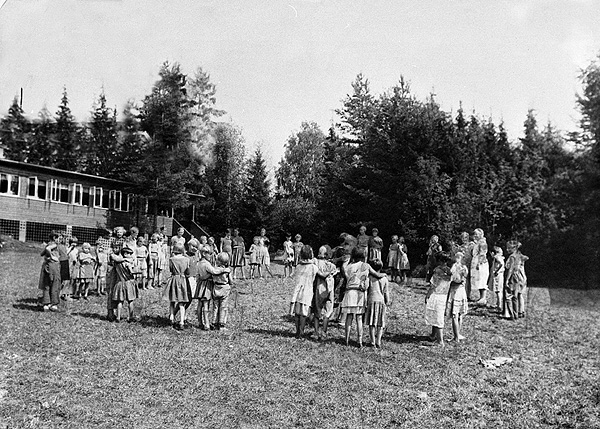
![]() |
| "Utøya- your own island!" Summercamps on Utøya were held since 1933. A series of historic photographs from the archives of the Norwegian labour movement |
“New Utøya” for 60 million Norwegian kroner to be completed by 2015 […] The background for this work is sinister, but we hope to rebuild Utøya, says[…]at the press-conference[…]We wish to honour the victims by keeping the island in use. It would be sad if the island became derelict and overgrown […]
Excised from
![]() |
| Plans for New Utøya. Copyright and Credit MIR AS and Fantastic Norway AS. Click for link to project description Official website of Utøya ww.utoya.no |
[…] no demolishments on Utøya before consensus
of all concerned parties is reached […] presented plans
for “New Utøya”. The previous day, the organisation applied for permission […] to demolish the cafeteria and pumphouse, locations where a large number
of youth were brutally shot and killed on July 22, 2011. Psychologist […] thinks the opinions of the bereaved families should weigh most” […] experienced as the location of many execution sites, it is not easy to re-imagine
it as a public place for recreation […]
Excised from http://www.tv2.no/nyheter/innenriks/22-juli-terror-oslo-og-utoya/auf-faar-ikke-rive-noen-utoeyabygg-3886624.html
Traumaexperts
ask to postpone Utøya-plans […] Several
bereaved experience new summercamps on the islands as a transgression. At the
same time many in AUF want to return to the island to honour the dead […] “I advise not to force decisions too heavy to bear for survivors and bereaved
families. It is important to take the time needed to really think through if
the island is to be used as before […]
Excised from http://www.aftenposten.no/nyheter/iriks/22juli/Traumeeksperter-ber-AUF-vente-med-Utoya-6935505.html
[…] “If they demolish
the cafeteria and pump-house as planned, we will also demolish parts of their
associated history. July 22 is part of our history, but it is also part of
Norway´s history” […] lost their
daughters in the atrocious attack on the island on July 22 last year. Together
with 200 other bereaved they sent letters to AUF, county and municipal
government and the Directorate for Cultural Heritage, requesting for Utøya to
be listed as a heritage site […]
[…] lost her son […] on July 22 last year. She reacts strongly to the plans for Utøya
presented today. “My message to […] is that he can forget
about rebuilding Utøya. This island should be listed. You can´t trample on the
grave of 69 people[…]have spent lots of time and resources on
the rebuilding of Utøya. I consider it naïve of them to believe that we who
have lost our children will accept this.” […] She is
supported by Utøya-survivor[…]who commented
on twitter “ […] shocked over how fast […] wants to start building work on the scene of massmurder, such politics
are inhumane” […] survived Utøya himself, but lost several
friends at the summercamp. He approves of the plans […] considers it important that Utøya continues to be actively used for
AUF´s political and social gatherings. “Some think leaving Utøya creates a memorial for the fallen […] this would be equal to making the island a trophy for the perpetrator” […]
![]() |
| An obvious association: "Die Toteninsel" by Swiss Symbolist painter Arnold Böcklin |
[…] Utøya is the scene of the biggest
peacetime massacre in Norway. It is our Auschwitz […] It would be
disrespectful against the dead and bereaved to arrange summercamps, parties and
recreation in such a place […] Utøya should be
preserved; it should be a site for silence and remembrance […] A monument against all the perpetrator stood for and did […] Let Utøya have the value it now has as symbol. Don´t trample on the
graves of the dead. Don´t open the scars after this national trauma. We should
let the dead rest in peace […]
![]() |
| Plans for New Utøya. Copyright and Credit MIR AS and Fantastic Norway AS. Click for link to project description |
[…] these acts of terror were public, but the killings of our loved ones and the grief over their loss are experienced privatly […] Utøya does not have to be listed for our loved ones to be honoured and remembered. Utøya is a crimescene, not a gravesite […] We wish that Utøya will be used to honour and remember our loved ones, by remaining a living island filled with active and dedicated youth. Excised from
![]() |
| Documentation of crimescene by the Norwegian Police, shown under the trial in 2012. The cafeteria building, where 13 bodies were found on the left. |
Thursday
San Francisco 1906
Ten minutes of mesmerizing film: San Francisco´s streetlife of 1906 documented through a camera mounted on the front of a streetcar.
Wednesday
Heritage as a political tool- cherry-picking historic layers to suit political agenda
Kossuth tér, Budapest´s symbolic square in the political centre of the nation is subject to a major remodelling project, that would simply edit politically unwelcome historical layers from public view. According to the parliamentary act signed by premier Viktor Orbán and his party Fidesz “the artistic appearance of the square is to be remodelled to correspond to its condition of before 1944”- a historically charged date, corresponding to the reign of Miklós Horthy over Hungary, who allied himself with Hitler´s Germany and approved of the deportation of more than 400.000 Hungarian jews to Auschwitz.
Critics point out that the remodelling of the square has deeper motives and demonstrate Fidesz´ unwillingness to distance themselves from the political ideas of the area . As part of wide reaching attempts to blank out certain parts of Hungarian history, statues of hated republican and leftist personalities such as count Mihály Károlyi (1875-1955) that were set up after 1944 would have to be removed. Additionally, fencing of the area for construction work, will hinder demonstrations of the opposition to Orbás´ government in front of the the neo-gothic parliament buildings, such as the Milla One Million for the Freedom of Press gathering in October 2011.This is a reminder that, as urban design is often derived from military strategies, the design of urban spaces is no accident and strongly connected to controlling the public.
Article in The Guardian on Hungarian Press Freedom
Article on The Hungarian Perspective
![]() |
| Kossuth memorial raised in commemoration of the rebellion of the people of Hungary against the Habsburg monarchy. To be edited from Kossuth tér square. Link |
![]() |
| Statue of Mihaly Károlyi (1875-1955), first president of the Hungarian republic founded after WWI. The center-left aristocrat is a hate-figure for the collective Hungarian right wing, Jobbik has been consistently pushing for its removal from "the Hungarian state´s main square". |
![]() |
| Attila József the best known of the modern Hungarian poets looking solemnly out over the Danube. He has all reason to, as the statue of this proletarian poet is also scheduled to be edited from the square. |
![]() |
| Proposal for new design of the square. |
![]() |
| Proposal for new design of the square. |
Tuesday
The public aesthetics of architecture
Thursday
The past is never dead. It is not even past.
“From the 7th day of my prison stay at Møllergata 19.
Have been in 2 interrogations.
Was flogged. Betrayed Vic. Am weak. Deserve contempt.
Am terribly scared of pain. But not scared to die.”
From the diary of Petter Moen
February 1944.
Left in an isolation cell in the notorious police quarters at Møllergata 19, the Norwegian resistance fighter Petter Moen uses the few things at his disposal to try make sense of his despair and what is happening to him. Letters, words, sentences slowly emerge by meticulously pricking toilet paper sheets with a found pin. He numbers and rolls the thin sheets to finally drop them down the prison´s ventilation shafts.
Petter Moen´s Diary, based on the recovered notes, is but one of many private diaries relaying the atrocious impacts of war and occupation on countless individual fates.
![]() |
| Trailer for the Spanish edition of the book "Petter Moen. Diario" A diligent translation of the diary into German is provided by Gisela Schneemann. |
In addition to constituting a contemporary historical document, the texts provide a fragmentary insight into a pained world of thought, which the author hardly intended to be dragged out into the light.
Its fragmentary debris in the form of diary pages and the prison cell reconstructed at Norway´s Resistance Museum have been taken on by the Austrian architect Dorina Dobnig.
Her project “Dagboken / The Diary” explores the notion of the building as a witness of a forcibly bared personal world of hope and hopelessness, self-scrutiny and escalating claustrophobia. The video installation, featuring dancer Kristian Alm accompanied by an acoustic composition by Gerald Krist, employs the body, its distorted movement and repetitive gestures devoid of meaning, as a tool for mapping the prisoner´s physical confinement.
“Dagboken / The Diary” is shown as part of the exhibition at Norway´s Resistance Museum in the same period that is covered in Petter Moen´s diary, February 10 to September 4.
The installation opens on Saturday, Feb 11, 2012, 12:00 at Norway´s Resistance Museum (Norges Hjemmefrontmuseum), building 21, Akershus Fortress, Oslo.
Dorina Dobnig in cooperation with:
image and technical solutions: Arne Langleite
sound: Gerald Krist
dance: Kristian Alm
Sunday
Parking in Style
A series of photographs from back in the day when owning a car was a luxury associated with certain obligations to style.
In response to the growing number of private cars in the inner city and the ensuing shortage of parking space, the first underground parking garage in Vienna, the Votivgarage, was opened in 1960. The prestigious project in the spirit of modernism featured drive-in banking, an underground bar and restaurant and hostesses on roller skates in red uniforms showing patrons to their parking spot.
![]() |
| All historic photos: WIPark |
Articles in Austrian newspaper Der Standard (in German):
Shocking Acts of Cultural Preservation and Repair
Les UX or Urban eXperiment is an underground organisation restoring or improving the city of Paris in secret, through repurposing hidden places, setting up pirate movie theatres and “shocking acts of cultural preservation and repair”.
Evolving from a group of teenagers dedicated to urban exploration of the hidden features of Paris since the early eighties, one of the sensational feats of UX´s subgroup Untergunther, specifically dedicated to restoration was the clandestine restoration of the Panthéon´s 19th century clock.
The Panthéon´s administration´s immediate reaction was to bring charges against the group.
"The New French Hacker-Artist Underground"- article by Jon Lackman in WIRED magazine.
"Pantheon, User´s Guide". Screenshot from a film by Lazar Kunstmann at Untergunther.
Saturday
Creating a better world for nothing?
![]() |
| "What if we create a better world for nothing?" Cartoon by Joel Pett |
Sunday
Goli Otok- an abandoned prison island in the Adriatic
Between the Croatian tourist islands of Rab and Krk , in the Adriatic sea lies a barren island, two by two kilometers in size, with strange ruins of prisons, bunkers and industrial sites.
Until the fall of communism Goli Otok, "the naked island" was a taboo in former Yugoslavia.
Today the island´s history is still an uncomfortable topic for many.
Austrian journalist Reinhard Grabner and camera man Franz Schwaighofer have now produced the first film about the island: "Strahota- Die Geschichte der Gefängnisinsel Goli Otok".
In 1949, the entire island was officially made into a high-security, top secret prison and labor camp run by the authorities of SFR Yugoslavia.
Goli Otok "was the private concentration camp of the Communist Party, more specifically: of Marshall Tito" says a former inmate, one of the contemporary witnesses interviewed for the film. Starting in 1948 critics not conforming to the system and political prisoners were confined to the island and subjected to forced heavy labor and tortorous abuse.
From the mid-60ies when also convicted criminals were imprisoned on the island "the prison situation normalised".
Over the course of four decades, apart from cell tracts and living quarters for the guards, the forced labour of the prisoners built a whole industrial zone, a number of factories for the production of furniture and tiles, even a pig farm that supplied the surrounding tourist islands. Former prisoners interviewed in the film tell about torture and abuse, and compare the conditions and the treatment with Guantánamo.
The island was eventually evacuated in 1988, leaving the facilities to decay.
"Strahota - Die Geschichte der Gefängnisinsel Goli Otok" premiered on May 5 2009.
A Croatian version is in the making. Alfred Pal, a former prisoner of Goli Otok plans to open an exhibition in Zagreb in July 2009.
Sources for further historic background and original photodocumentary material:
article in the Austrian newspaper derstandard.at (in German)
website about the film "Strahota- Die Geschichte der Gefängnisinsel Goli Otok
goliotok.com photodocumentation about the island
"Golit Otok- hell in tourist´s paradise" , photodocumentation about the island Goli Otok
"Die nackte Insel" a visit of Goli Otok- article in "Neue Zürcher Zeitung"
historical-political background (pdf, in German) from www.fraumuennich.de
"Goli Otok- hell in the Adriatic" book review
Thursday
Communities, ecomuseums and sustainability
Ecomuseum in Rennes, France by Nantes-based architects Guinee Potin. article at designboom.
image: Stéphane Chalmeau.
My review of a lecture at University College London by Peter Davis, author of Ecomuseums: A Sense of Place.
Link to article on UCL´s events blog.
Who decides what should be regarded as heritage? Dorina Dobnig, an MSc Sustainable Heritage student, discusses a guest lecture given by Peter Davis (Professor of Museology at the International Centre for Cultural and Heritage Studies at the University of Newcastle) on the concept of the ecomuseum.
Professor Peter Davis presented his lecture ‘Communities, Ecomuseums and Sustainability’ to a mixed audience of students, academics and members of the museum and heritage professions at the UCL Institute of Archaeology on 20 January.
The concept of the ecomuseum or ‘ecomusée’ was developed in France by George Henri Rivière and Hugues de Varine as a reaction to traditional museum concepts.
Ecomuseums are community-based heritage projects that support sustainable development – a counterbalance to ‘top-down’ institutional approaches to communities that democratises the operative structures of cultural heritage interpretation and challenges the spatially bound traditional museum models.
In his lecture, Davis elaborated on ecomuseums as both mechanism and process, and the significance of their characteristics specifically in relation to the empowerment of local communities, who can make their own decisions about what constitutes their heritage and the creation of different forms of capital, cultural and otherwise.
As such, no single authoritative model for ecomuseums exists. Rather, the ecomuseum is what Davis calls a “toolkit of heritage practices” that may be adapted to the heritage of specific territories not necessarily defined by conventional boundaries, but instead, for example, by a common landscape, dialect, industry or musical tradition.
Local communities are at the heart of the ecomuseum philosophy and Professor Davis demonstrated its application in a deliberately broad scope of case studies, openly discussing the varied results and impacts on the respective communities, their identity and the challenges in sustaining community-supported ecomuseum practices in the longer term.
Among the wide range of eco-museums discussed were the Ecomuseo de Canapa, Carmagnola in Piemonte, Italy; Kalyna Country, the “world´s largest ecomuseum” for Ukrainian culture in Canada; the Japanese ecomuseums of Asahi-machi, Yamagata and Hirano-cho, Osaka as well as a group of Chinese ecomuseums initiated by a Sino-Norwegian cooperation project.
In his analysis of differing approaches to balancing visitor and community interests, cultural tourism, fragmentation of sites and content, community involvement, and the degree to which ‘heritage professionals’ and financing authorities influence the process in the specific countries, Davis assessed the wide-ranging applicability of the ecomuseum model as a highly flexible framework based on a holistic understanding of the history of a place.
Professor Davis’s book Ecomuseums: A Sense of Place will be published in a revised second edition in March 2011.
Tuesday
brick rustling
Brick by Chance and Fortune is a documentary by director Bill Streeter, premiering at the St. Louis Filmmakers Showcase about the rich heritage of brick architecture in the town of St. Louis and the accompanying severe problem of brick theft, resulting in the demolishing and ruination of whole buildings in order to salvage valuable brick material.
link to film
link to New York Times article on brick theft in St. Louis
link to extensive article on treehugger on the "harvesting" of building materials and metals from the built environment.
link to article "Where stolen bricks go"
A brick valued at 3,000 UKP was stolen from an art gallery and replaced by an ordinary substitute.
Nuts and Bolts
Another example of valuation and valorisation out of context- a bolt of Yuri Gagarin´s Vostok space craft is available for auction. The current bidding price is 2,800 dollars, and expected to rise over the next days. I´d love to own that- but maybe not at this price. But what would it be worth to you?
Link to the auction
Link to the auction
Friday
Time travel is verboten!
Expanding on my current China theme:
This article (via BoingBoing) gives background on an impending official ban by China´s General Bureau of Radio, Film and Television on the production of a genre that has increased in popularity recently: time-travel .
In these fictions the main characters find themselves transported from the contemporary to an era of China´s historical grandeur.
A nostalgia for such imagined pasts is perceived as reactionary and disrespective of history by the authorities.
This article (via BoingBoing) gives background on an impending official ban by China´s General Bureau of Radio, Film and Television on the production of a genre that has increased in popularity recently: time-travel .
In these fictions the main characters find themselves transported from the contemporary to an era of China´s historical grandeur.
A nostalgia for such imagined pasts is perceived as reactionary and disrespective of history by the authorities.
![]() |
| Culture Shock between the contemporary and the historic. Image: still from the television series Shen Hua (Myth) |
Thursday
museum boom in China
![]() |
| China National Film Museum founded 2005, the world´s largest professional museum (not counting ecomuseum-regions)- with an architectural space of 38,000 sqm image source: wikimedia commons Carla Antonini |
China´s cultural infrastructures are under vigorous development- but what concepts of heritage and culture does the Chinese state want to establish and support?
"China´s New Age of Enlightenment" - from an article in the Art Newspaper:
"As of 2009 there were 3,020 museums in China, including 328 private museums (the American Association of Museums estimates 17,500 in the US). One hundred new museums are being added each year. In March the government made entry to museums of modern and contemporary art free. The torrid pace of museum development is part of a national drive to build cultural infrastructure and, as Cai Wu, the minister of culture, put it earlier this year in a published comment, “to establish a batch of world-famous cultural brands.”
“The next ten years should be a golden period for the development of every aspect of cultural industries in China,” said Ye Lang. “The country isn’t just satisfied with the economic achievements it had made,” the Xinhua news agency announced in January. “What it now needs is all-round cultural influence on an international scale.” The government backs these ambitions with a cultural outlay of $4.45bn in 2009, excluding construction costs."
Hypothetical adaptive re-use
Artist collective the Hypothetical Development Organisation, "dedicated to the recognition and extension of a new form of urban storytelling", has developed alternative perspectives towards the re-use of abandoned structures. Ten abandoned buildings in New Orleans were given hypothetical futures, "not bound by rules relating to commercial potential, practical materials, or physics". In accordance to their motto, "You won´t believe our plans!", among the suggested developments have been a Loitering Centre, a Rubble Depot and an Authenticity Monument of a building in disrepair, to be conserved "as found".
To quote Architizer:
"A brilliant way for architects to use those $100K rendering skills to actually do something with some impact on a community, besides warning people about the fresh hell their neighborhood is about to go through with the construction of that new 57-story tower."
Read more on their New Orleans development projects- link
![]() |
| Museum of the Self. Image: screenshot Hypothetical Development Organization |
"A brilliant way for architects to use those $100K rendering skills to actually do something with some impact on a community, besides warning people about the fresh hell their neighborhood is about to go through with the construction of that new 57-story tower."
Read more on their New Orleans development projects- link
Subscribe to:
Posts (Atom)